Co-founding and designing a wellness brand that tries to bridge 4,000 years of Traditional Chinese Medicine with the design language of modern American wellness — from logo to packaging to go-to-market.
"We couldn't find a tonic herbal supplement that worked as promised and felt like a joy to use, so we tried to make one ourselves."
Growing up in China, Traditional Chinese Medicine is a daily practice — prevention over treatment, harmony over intervention. Moving to the U.S., the supplement aisle felt like a different world: clinical, transactional, and somewhat distant from the 4,000 years of practice behind the herbs it sold.
That gap became Yīngredient. The brand sources geo-authentic botanicals from their regions of traditional origin, formulates them with credentialed practitioners, and presents them in a visual language closer to the modern wellness aisle than the supplement one.
I co-founded the company with Aleks Barszczewski and led the design side — logo, packaging, photography direction, and the typography system.
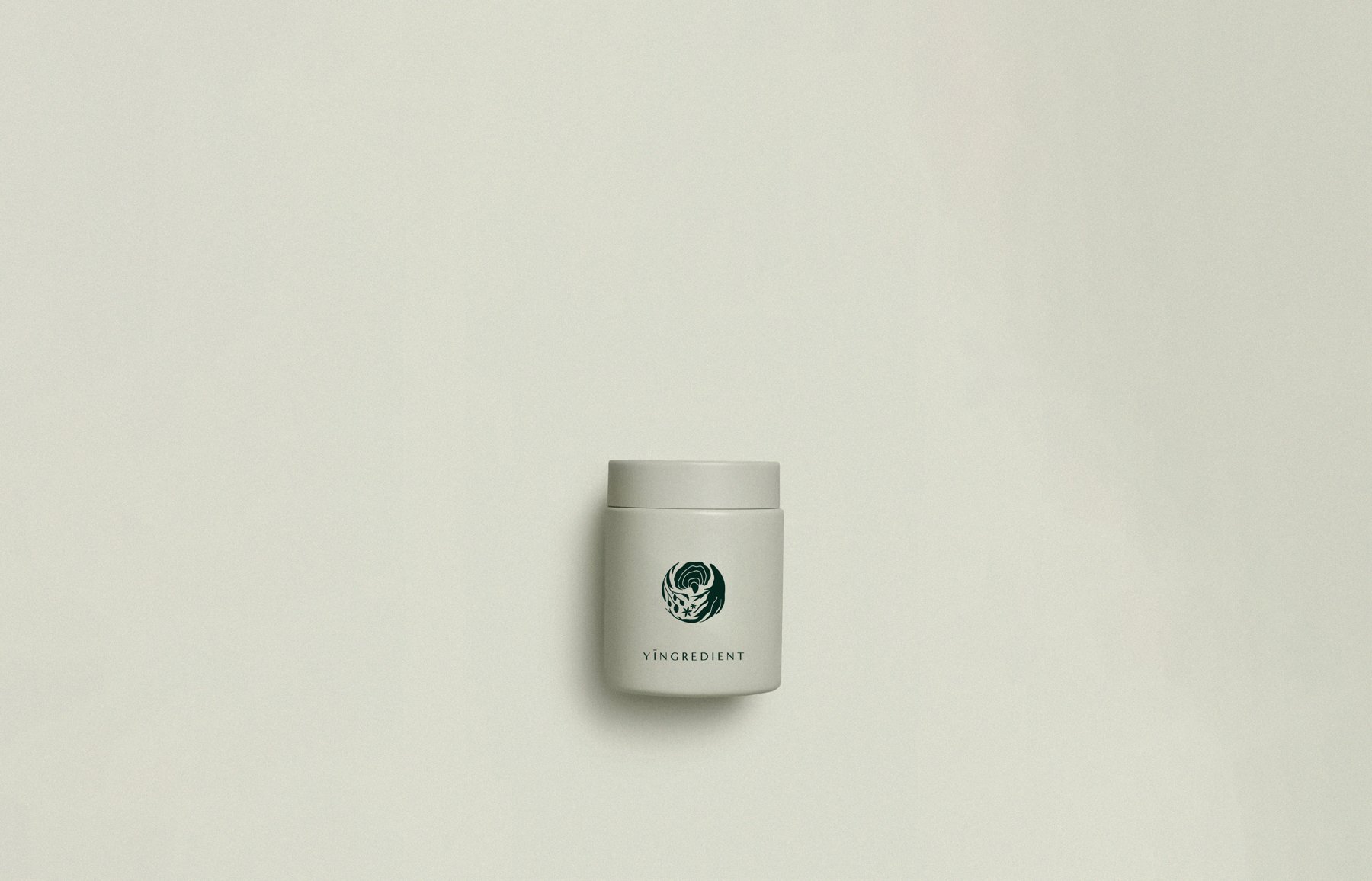
The logo mark is a hand-drawn abstraction of the botanicals inside the formula — circling back to itself like a Chinese garden door. The wordmark is set in a transitional serif chosen for restraint, not display.
Existing TCM products tend to sit between traditional roots and modern aesthetics. As consumers increasingly value experience and design, that's the gap Yīngredient is trying to address.
Crafted with Traditional Chinese Medicine principles to support longevity by nourishing your Jing. The blend was developed in collaboration with three credentialed practitioners — Chris Freeman (MAcOM, LAc), Dr. Ann Wang (CMD, LAc), and Maya Merchant (MS/LAc).
Packaging is a matte cream jar with the logo mark and wordmark in deep forest — a deliberate departure from the white-and-blue clinical look that dominates the category.
We partner with farms that are known for sustainable and ethical practices, building direct relationships rather than buying through anonymous middlemen.
Traditional and modern medicine blended with scientifically-proven herbs for evidence-based consumers.
Expertly formulated by renowned doctors and practitioners — filling a real gap in a category dominated by generic blends.
Attention to detail and craftsmanship in everything — from formula to fill, from jar weight to label paper.
Raising TCM awareness through newsletters and content — building a deeper understanding of what these herbs actually do.
Products that look beautiful and function well — thoughtful, sustainable design that earns its place on the shelf.
A premium price requires receipts. These are the systems built into the supply chain so the brand can hold up to scrutiny.
~95% of raw herbs come from their "Dao Di" — the regions of traditional origin. Sourced from 300+ farms across 22 provinces in China.
A unique tracking system manages data from seeds to finished product. Cultivation, production, commercial — fully traceable.
Partner labs certified by ILAC-MRA/CNAS — accreditation recognized in 28 countries including the U.S., U.K., Germany, and Japan.
Print, packaging, lifestyle photography, and social each pull from the same compact set of marks, colors, and type rules.
A quieter, more considered take on a category that often feels clinical.
Multiple design awards under Phoenix Design Studio. BFA in Product Design from Parsons. Entrepreneur Program at Stanford. Experience across product, communication, and brand design.
Previously an investor at Pegasus Tech Ventures, a Silicon Valley fund. Background in investment banking, private equity, and private debt. BS in Information Systems from Fordham University.